
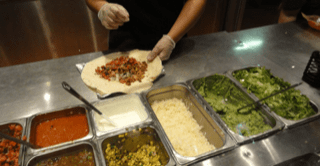
Another lunchtime. Another Tuesday.
Where to grab a quick, healthy bite?
I settle on Chipotle. It’s been a few weeks since it’s made my lunch rotation.
I drive the couple blocks. Park my minivan. (Yes, I’m still driving one—even with two in college.) After a quick stand in line, it’s my turn at the counter.
“What can I get you?”, says the rice-and-beans-and-meat guy in his early twenties.
“Steak bowl—brown rice, black beans, some pepper,” I say. My usual.
He assembles. With quick hands and without a word, he slides the bowl down the counter and turns to the next customer.
I move with my bowl, and am now the responsibility of the salsa-and-toppings guy. (This one, too, in his early twenties.)
Again, my usual. It is a Tuesday after all.
The “mild, medium, corn, cheese and lettuce” gets efficiently spooned, sprinkled, and arranged.
He gently cups both hands atop the lettuce, shaping the end product to ensure nothing rolls off onto the steel countertop.
The stacking is more deliberate than normal. But everything is as your fast and efficient as it should be.
And then.
With a smile, the young man (let’s call him “John”, I don’t recall a name tag) looked up from his creation and straight at me.
“How does that look?” he asks, pointing down at the meal with his chin, and a hint of pride.
Admittedly, sometimes I don’t get tone and true intention, this fella sounded genuinely interested in my answer.
“Looks great,” I said.
It did, too. Not too big. Not too small. The stack stand-out neat and symmetrical.
His short, quick question came out smooth, natural. And yet out-of-the-ordinary: I wasn’t expecting to be asked for feedback.
And while it took a few seconds for me to appreciate what had just happened, a slow smile crept across my face.
Someone actually cared enough about what I thought of the meal to ask.
It could’ve been too light on the beef, or heavy on the cheese, or out of balance in some way. Someone—and not just the cashier at the end of the line—wanted to know.
I ate my lunch.
Yes, alone with my phone. But a bit happier for a Tuesday.
***
Whether or not he knew it, John’s simple four-word “How does that look?” was textbook — straight out of Customer Service 101.
Over the years, those little promptings for feedback at the end of a customer journey—or in the middle of one—have taken many forms, and varied by industry:
“How is your flight?” (airlines) “Does that feel better?” (healthcare) “Starting to make sense?” (education) “How did you sleep?” (hotels) “Finding everything OK?” (big box stores)
John was doing that: soliciting feedback in an attempt to head off a potential problem—even if that “problem” would ultimately prove only a minor dissatisfaction, and one likely to remain unspoken and unreported.
After all, the majority of consumers never speak up about their unhappiness with a purchase, especially in public, or when they’re in a rush to get on with their day, or when that dissatisfaction fails to justify the discomfort and delay which comes with reporting it.
So why did John ask?
Maybe he was told to by his manager. Perhaps that particular store had been struggling to get portions right, to perfect the process and aesthetics of meal assembly. Had there been a string of recent customer complaints? I have no real way of knowing.
I didn’t overhear John pose the question to the customer ahead of me in line. Nor the one after. He may have, of course. I wasn’t paying attention.
And if it was just me, then why me? I don’t think I looked particularly unhappy, hard to please, quick to complain. (Gee, I sure hope I don’t give off that vibe.)
I am getting older—growing greyer. Perhaps it was the age difference between this early Gen-Xer and a late-Millennial that prompted his query? Maybe I reminded him of his Dad? (Or, God forbid, his grandpa?) Or could he have seen me as a potential mystery shopper? I suppose anything’s possible.
What I can know is that sometimes—in the wide world of customer experience—brief moments, small interactions, even quick glances can be windows onto a broader terrain.
Case in point, John’s ask for feedback.
Feedback is something that has evolved in recent decades into more science than art. In this digital age of cross-channel customer journeys, where online channels and real-world brick-and-mortar are being integrated to create unified customer experiences, the ‘5 Ws and an H’ of feedback have exploded in complexity.
Who to ask for feedback? The import of collecting representative data, and providing all customers the opportunity. Prioritizing the right segments. Using the best sampling strategies.
What to collect? Understanding what makes a particular customer journey successful so you can know what to ask about. On which metrics to focus: process vs. performance?
When to solicit? Reaching out at the right time. If it’s feedback about a specific step in the journey you’re after, then ask immediately on the heels of the trigger event. If it’s the health of a whole relationship, ask periodically in real-time.
Where to get responses? Feedback must come through channels that are easy and relevant. If the company is initiating the ask, then someone needs to decide when to use email-to-web, SMS, phone or IVR, or the back of a printed receipt with a link to the web.
Why to collect? For what purpose? What are you after? Gaging the ease, efficiency of an event? Diagnosing the health of an end-to-end customer relationship?
How to design the survey? Structure the survey. Write the survey. Get higher response rates. Reduce survey abandonment.
Of course, all of these considerations were greatly simplified in the moment of John’s natural—most likely, intuitive—ask.
And yet it still makes for an interesting lens through which to view his action, its meaning, its impact.
Who? (Just me.) What? (My take on his work—the end result of which was sitting right there on the counter between us.) When? (Right then.) Where? (Right there.) Why? (He actually cared and was curious.) How? (He asked, I responded, he listened.)
Not surprisingly, real-time feedback has it’s advantages.
Brands have learned through online trial and error that making a request (1) immediately after a trigger event (2) with a short ask (3) that’s optimized for mobile gets significantly higher response rates. And that’s even more true in the real world of face-to-face, brick-and-mortar.
Then there’s John’s attempt to prevent a problem rather than having to fix one.
CX research now shows that the best way to address a customer disappointment is to prevent it in the first place. And while John may not be up on the latest consumer research, his actions suggest he intuitively ‘gets’ that it’s better-to-prevent-than-to-fix.
The natural human impulse of many to seek to please rather than offend turns out to be rather helpful in a customer environment.
According to recent research by Medallia, a leading CX software as service provider, consumers today are generally unimpressed with what brands actually do to address disappointing customer experiences. So brands are nearly always better off trying to prevent them.
Perceptions of unfair treatment can be particularly upsetting for customers. Neuroscience is teaching us that unfair treatment can elicit strong reactions, akin to a threat response. In addition to increasing churn, many consumers will respond by sharing negative word of mouth and of venting their anger on social networks.
And these brand-damaging behaviors are especially likely when customers believe that they have put in more effort than the company to resolve an issue.
Turns out, that inherent sense of fair play—namely, that you shouldn’t have to work harder to correct a problem than the party most responsible for causing it—is a big driver of consumer behavior.
Chipotle restaurants can sometimes feel cold, impersonal, unwelcoming.
Maybe it’s all that industrial-style concrete and metal. Maybe it’s the assembly-line feel that comes with witnessing your meal built with efficiency and precision. Maybe it’s the fact that, all too often, you come away feeling that it is as much you being processed in that assembly line as it is your food.
Good thing the food is so good.
Maybe it was that cold impersonality that kept me away from Chipotle for the weeks leading up to this visit.
***
Actually, that single rapid-fire ask-and-response wasn’t the end of my exchange with John that day.
In the twenty seconds or so I waited for the cashier to ring me up, John managed to hustle from one end of the counter to another, retrieving and folding a tortilla for the next customer.
Those seconds gave me a chance to process.
As I prepared to take a seat with bowl in one hand and cup in the other, I turned back toward John.
“Hey there,” I said. “That asking me if my food looked OK was a nice touch. Good on you, man.”
His response?
“It really helps, right?”
With that, I knew two things.
First, that he’d asked the question before…If not with everyone, then regularly.
Second, that what I had suspected was true of John: He was the type who’s a natural with customers…emotionally intelligent, confident, eager to please, quick with a smile.
He instinctively gets that the folks who visit Chipotle at lunchtime on a Tuesday come mostly for the good food.
And yet, it’s serving that food with noticeable care that can build — and differentiate — a brand.
Erik Kridle is a freelance marketing and employee comms writer living in Orange County, CA. He brings the worlds of customer experience (CX) and employee experience (EX) together for brands passionate about activating their workforce to deliver extraordinary customer experiences. This coming Tuesday you can find him eating lunch at his local Chipotle restaurant.
 KridleContent:)